On hazelnut exchanges, "Giresun quality" trades as a class of its own. Behind that distinction lie both geography and a formal registration.
Because of the quality the Tombul variety shows in the ecology where it grows, the Turkish Patent and Trademark Office granted it a geographical indication certificate in 2001 under the name "Giresun Tombul Hazelnut".
The second and more significant step came in 2022. Following an application by FİSKOBİRLİK, the product was registered as a designation of origin in the European Union by a decision published in the EU Official Journal of 20 June 2022. Giresun Tombul Hazelnut thereby became the eighth Turkish product registered in the EU.
The registration protects the product against imitation and evocation within EU borders.
Geographical indications fall into two categories, and the difference matters.
With a protected geographical indication, at least one production stage takes place in the stated region; other stages may happen elsewhere. With a designation of origin, all the product's characteristics are tied to a specific geography and the entire production must occur within those boundaries.
Giresun Tombul Hazelnut is protected as a designation of origin. To use the name, the hazelnuts must be grown within the province of Giresun or in the Beşikdüzü and Vakfıkebir districts of Trabzon.
Tombul saplings can be planted elsewhere. But this is precisely the logic of geographical indication: what defines the product is not the variety alone but the ecology in which it grows.
The sloping terrain of the Black Sea coastal strip, the altitude band between 200 and 750 metres, the humidity and the soil cannot be transported. The same sapling in another climate yields a different oil content, a different aroma and a different kernel ratio.
The clearest illustration came from industry: an international chocolate manufacturer's alternative growing investment in Australia failed to match the quality sought, and the supply route turned back to Türkiye.
Registered products are inspected regularly. In a study of samples taken from growers' orchards in 2017 and 2018, the following values were measured:
Average nut size 17.12 mm, kernel size 13.32 mm, nut weight 1.66 g, kernel weight 0.87 g, husk length 42.5 mm and an average of 3.43 nuts per cluster.
Biochemical analysis found linoleic acid at 9.45%, palmitic acid 4.86%, stearic acid 2.55%, palmitoleic acid 0.20% and linolenic acid 0.08%. Oleic acid is the dominant component of this profile.
Nut weight and kernel ratio determine how much edible product you get per kilogram. A thin shell and a high kernel ratio mean more hazelnut for the same weight.
Fatty acid composition directly affects taste and durability. A high oleic acid share helps preserve aroma during roasting and slows the deterioration of the oil. The texture and shelf life of hazelnut butter are tied to the same composition.
A geographical indication is not a marketing label but a supervised standard. Compliance with the local production techniques set out in the registration certificate and product specification is mandatory. The measurements above were themselves made as part of those inspection activities.
For the consumer this means: the geographical indication on the label is not a producer's own claim but a standard checked regularly against defined physical and chemical properties.
Directorate for EU Affairs of the Republic of Türkiye, "Giresun Tombul Hazelnut Registered as a Geographical Indication in the European Union", 2022.
FİSKOBİRLİK official announcement, June 2022.
Bahçe Journal, "Some Properties of the Geographically Indicated Giresun Tombul Hazelnut", DergiPark, 2024.
Official Journal of the European Union, L 164, 20 June 2022.
How soil, climate and altitude combine to give Giresun hazelnuts their distinctive aroma.
Read article →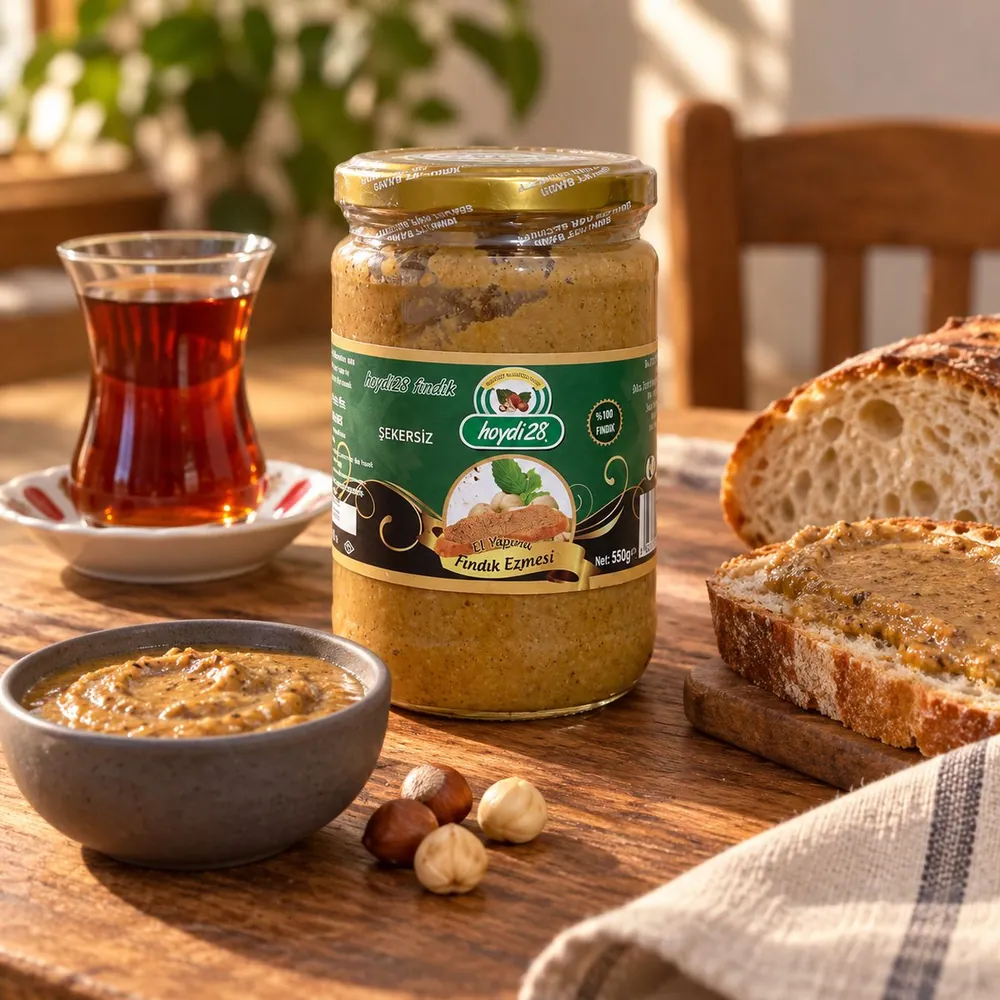
How to keep an opened jar fresh and smooth for months.
Read article →
Why hazelnut boxes stand out for New Year and special-occasion gifting.
Read article →Karadeniz Fırtınası is made with hazelnuts alone. We use no fillers, flavourings, preservatives or emulsifiers, what the label says is exactly what’s in the jar.
 Chat on WhatsApp