Aflatoxin is one of the most closely monitored issues in food safety, and it matters particularly for Türkiye as a hazelnut-producing country. Let's set out the facts without overstating them.
Aflatoxins are toxins produced by certain moulds, chiefly *Aspergillus flavus*. The mould can develop both in the field and in storage under the right conditions of moisture and temperature.
The difficulty is that aflatoxins are **very stable compounds**; they are not readily broken down by roasting or other heat treatments. The main strategy is therefore to prevent their formation in the first place.
The European Commission sets an upper limit of **5 μg/kg** for aflatoxin B1 and **10 μg/kg** for total aflatoxins in hazelnuts intended for direct consumption.
Moisture content is also regulated: a maximum of 12% for in-shell hazelnuts and 7% for shelled kernels. In commercial practice these figures are kept lower still, around 10% for in-shell and 6% for shelled.
These numbers are not arbitrary. Moisture content relates directly to the water activity that mould needs to develop.
The most effective way to prevent aflatoxin is **rapid, correct drying** after harvest. The literature emphasises drying within 72 hours of harvesting.
In a study on hazelnuts artificially inoculated with *A. flavus*, the effect of drying at different temperatures was measured. The results were striking:
In nuts dried at 30, 35 and 40°C, mould **increased**, with the highest concentration at 35°C. Aflatoxins were detected at these temperatures.
By contrast, **no aflatoxins were found in nuts dried at 45 or 50°C**, either after drying or after storage. A reduction in viable mould spores was also observed.
The researchers' conclusion was clear: shorter, warmer drying is essential for product safety.
The logic makes sense: warm, damp conditions are ideal for mould. Slow drying gives it time.
In a three-year study across three producing regions of Azerbaijan, two drying regimes were compared: good drying (sun-exposed, mixed, protected from rewetting) and bad drying (shaded, piled, rewetted).
Samples were then stored either cold (8-10°C) or at room temperature (18-22°C). Mould prevalence and aflatoxin levels were measured to assess the effect of post-harvest practices.
The lesson applies to consumers too: **rewetting is the biggest risk.** Dried nuts absorbing moisture again creates ideal conditions for mould.
A comprehensive 2025 study measured the effect of roasting, blanching and mechanical or manual sorting at pilot and industrial scale.
The findings: **sorting proved highly effective.** Higher roasting temperatures produced statistically significant reductions in aflatoxin levels. In artificially inoculated samples, roasting cut aflatoxin concentrations by **more than 97%**. Across the complete processing sequence, overall contamination fell by roughly **98%**.
The same studies point to an important detail: aflatoxins concentrate mainly in the **hazelnut skin and the rejected fractions**.
When the skin was analysed after roasting, residual aflatoxin in the skin ranged from 80% to 100%. The toxin accumulates in the outer layer rather than the kernel.
This shows that removing the skin also serves a food safety function.
Discard any nuts with visible mould, darkening or shrivelling.
If you detect a mouldy smell, do not use the product. Aflatoxin is invisible, but the presence of mould is a warning sign.
Do not store hazelnuts in damp places. Bathrooms, basements or the area near a dishwasher are unsuitable.
Keep opened packs sealed and eat them within a reasonable time.
Buy from an inspected supply chain. Registered food businesses carry out regular analyses.
No. Türkiye conducts regular aflatoxin testing for both export and the domestic market, and the limits are aligned with the EU.
The data above show the risk is manageable and that a correct harvest-drying-sorting chain resolves most of the problem. The aim here is not to alarm but to explain why the process is handled so carefully.
European Commission, maximum levels for aflatoxin and moisture content in hazelnuts.
Prelle A. et al., "Effect of Drying Temperatures and Exposure Times on *Aspergillus flavus* Growth and Aflatoxin Production on Artificially Inoculated Hazelnuts", Journal of Food Protection.
Özer H., Arısan Ataç I., "Effects of Physical and Thermal Treatments on Aflatoxin Contamination in Hazelnuts", 2025.
Siciliano I. et al., "Static Hot Air and Infrared Rays Roasting are Efficient Methods for Aflatoxin Decontamination on Hazelnuts", Toxins, 2017.
"Effect of Post-Harvest Management on *Aspergillus flavus* Growth and Aflatoxin Contamination of Stored Hazelnuts", three-year field study.
How soil, climate and altitude combine to give Giresun hazelnuts their distinctive aroma.
Read article →
How to keep an opened jar fresh and smooth for months.
Read article →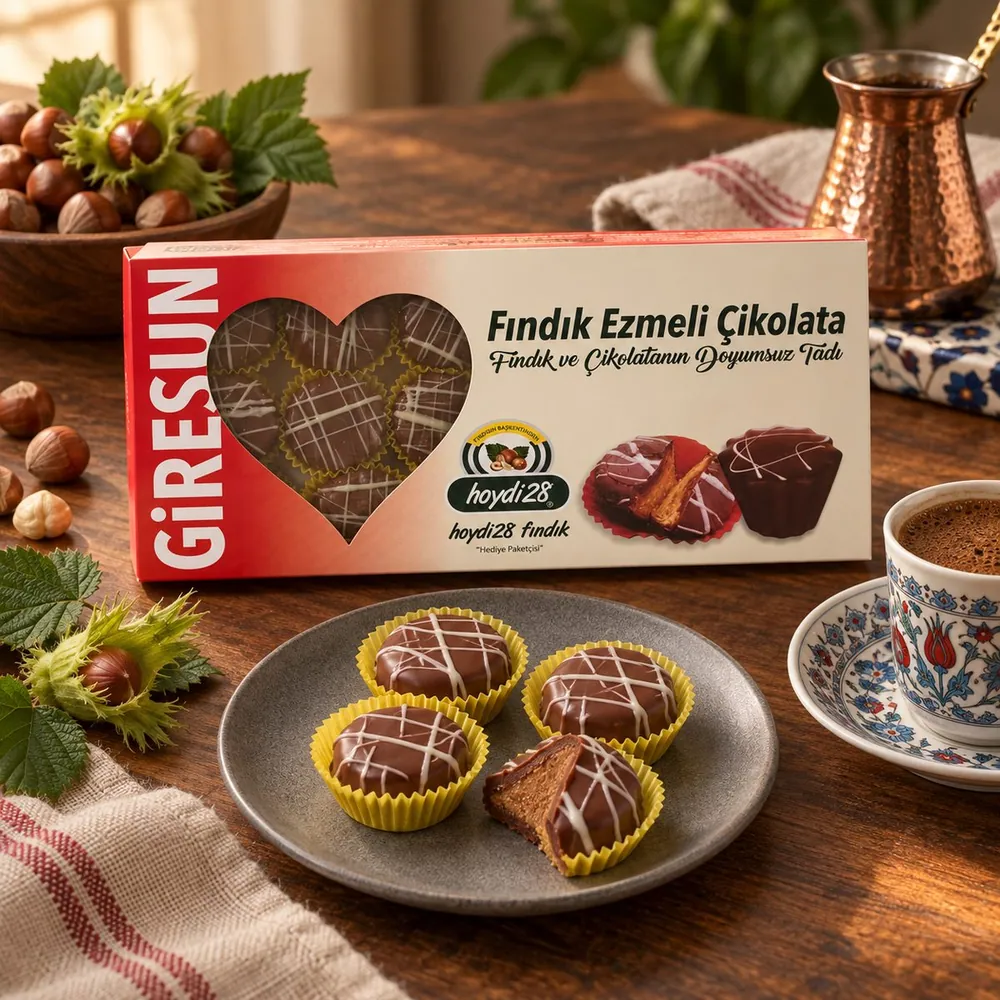
Why hazelnut boxes stand out for New Year and special-occasion gifting.
Read article →Karadeniz Fırtınası is made with hazelnuts alone. We use no fillers, flavourings, preservatives or emulsifiers, what the label says is exactly what’s in the jar.
 Chat on WhatsApp